


There are artists who create from ambition, and artists who create from memory. Then there are very few amongst us that create for joy, like Anita Davenport, joy is neither a whimsical feeling nor a passing emotion, but rather a deep-rooted feeling that has been simmering within you since your youth and is ready to come forth to bloom when the time is right. For Anita, that time and place came while at The Lot at Formosa in Hollywood, under lights that once illuminated Marilyn Monroe and Natalie Wood. Anita stood backstage, barely breathing, as her first LA Fashion Week collection began its slow glide into the world. Each look that stepped forward was a story, bright, textured, and rhythmic. Anita watched, suspended somewhere between disbelief and understanding. “It felt surreal,” she told me. “Like watching a dream, I didn’t even know I was allowed to have finally take shape.” There was no drama with Anita Davenport’s statement; she said it the way someone describes a long-awaited sunrise.
Anita Davenport is a designer whose name has become synonymous with color, creativity, and purpose ever since the debut of her brand, SingleTree Lane. But to understand why her work lands the way it does, you have to understand that she didn’t come to fashion chasing relevance or trend forecasts. She came to it the same way people come to music when they’re kids, because it felt like home. Growing up, color wasn’t decoration for Anita. It was language. It was how culture spoke, how history survived, how joy resisted erasure. She absorbed textures and patterns the way some people memorize lyrics, storing them quietly, without any immediate plan. Fashion, at first, wasn’t the goal, the expression was.
“Color, texture, and patterning have been part of my DNA since my early days in elementary school,” Davenport says. “I didn’t realize it then, but I was developing the visual instincts I use now in every collection.” That creative instinct is what poured onto the LA Fashion Week runway. Models in vivid, globally inspired prints moved with a confidence that felt less like choreography and more like permission. The clothes didn’t ask to be understood; they invited you in. By the time the final look disappeared backstage, most of the collection had already sold.
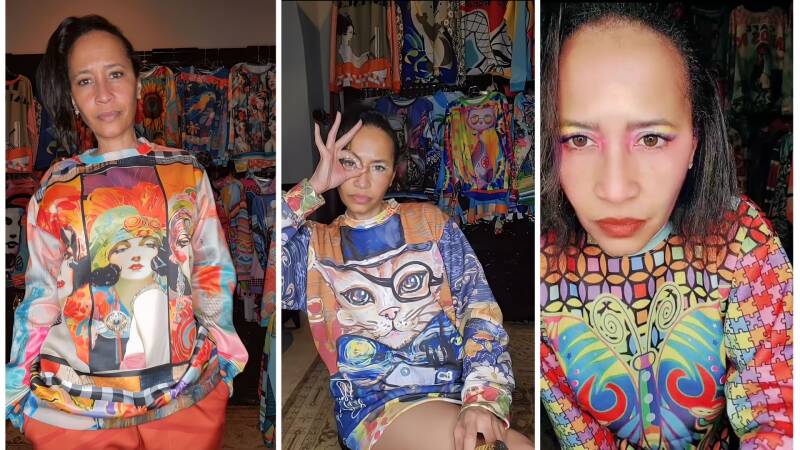
For a first-time showing, it was the kind of success that usually comes with an asterisk. Hype. Backing. A machine. Anita felt her moment of recognition was different from others like it, because she had spent years working in silence prior to this time when people began to take notice of her work. “It was overwhelming in the best possible way,” she stated . “It felt like validation, not just of the designs, but of the spirit behind them: color, culture, joy, and unapologetic self-expression.”
Then she decided to let me in on the real truth. “This is bigger than fashion,” she said. “This is the purpose.” The brand of "SingleTree Lane" was established with the best of intentions by Anita. For Anita, being "sustainable" is more than a trendy term; it is an integral part of her work as a businesswoman. In discussing the materials used in the creation of SingleTree Lane, Anita demonstrates the same reverence for these materials that a musician has for their instrument. Every choice carries weight. Every piece has a reason to exist. In a fashion industry addicted to speed, Anita moves deliberately. She designs like someone who understands that what we wear becomes part of our memory, photos, milestones, moments when we needed to feel like ourselves again. Her clothes don't costume identity; they honor it.
This speaks to a level of humanity that many of us feel and can appreciate. Since people can relate to this on such a personal level, they were feeling it throughout the performance. The people weren’t just admiring craftsmanship; they were recognizing themselves, and or maybe who they wanted to be. That’s the thing about joy, it’s contagious when it’s honest. Anita doesn’t present herself as a visionary in the mythic sense. She doesn’t talk about “disrupting” fashion or redefining anything. She talks about connection, about lineage, and about making room.
“My purpose is to bring color, healing, and expression into people’s lives,” Davenport says. In an industry of cool that usually focuses on exclusion; this is an extremely bold statement. After the LA fashion show, while everyone was enjoying the scenic view at The Lot at Formosa, applauding, congratulating, and thanking each other, Anita remained true to herself. She hugged her team, she laughed, and she took it all in without trying to own it too comfortably. Success, for her, wasn’t a finish line, it was a confirmation for her successful outcome. She was walking with a purpose in the right direction.
Each artist has a moment where they experience their dreams as real rather than imaginary. That experience can be a mixture of excitement, joy, and fear because now they have something to protect. Anita understands this as well, as Anita knows and understands another equally important fact: The joy of art grows with the sharing of it, and that joy will not be affected by how many people have viewed it. SingleTree Lane feels less like a brand launch and more like the opening track on a record that’s been waiting years to be played.
If this debut was the introduction, then what comes next won’t be about scaling up or chasing louder rooms. It will revolve around being yourself and staying true to yourself. Staying true to who you’ve always been and not reinventing yourself to fit into a world that idolizes reinventing yourself is the greatest act of rebellion in a time when a majority of people are obsessed with reinventing themselves. Anita Davenport is quietly leading others back to authenticity, it’s a new revolution. She’s helping others to remember what has always existed within ourselves.

Add comment
Comments